How (not) to learn with AI
Introduction
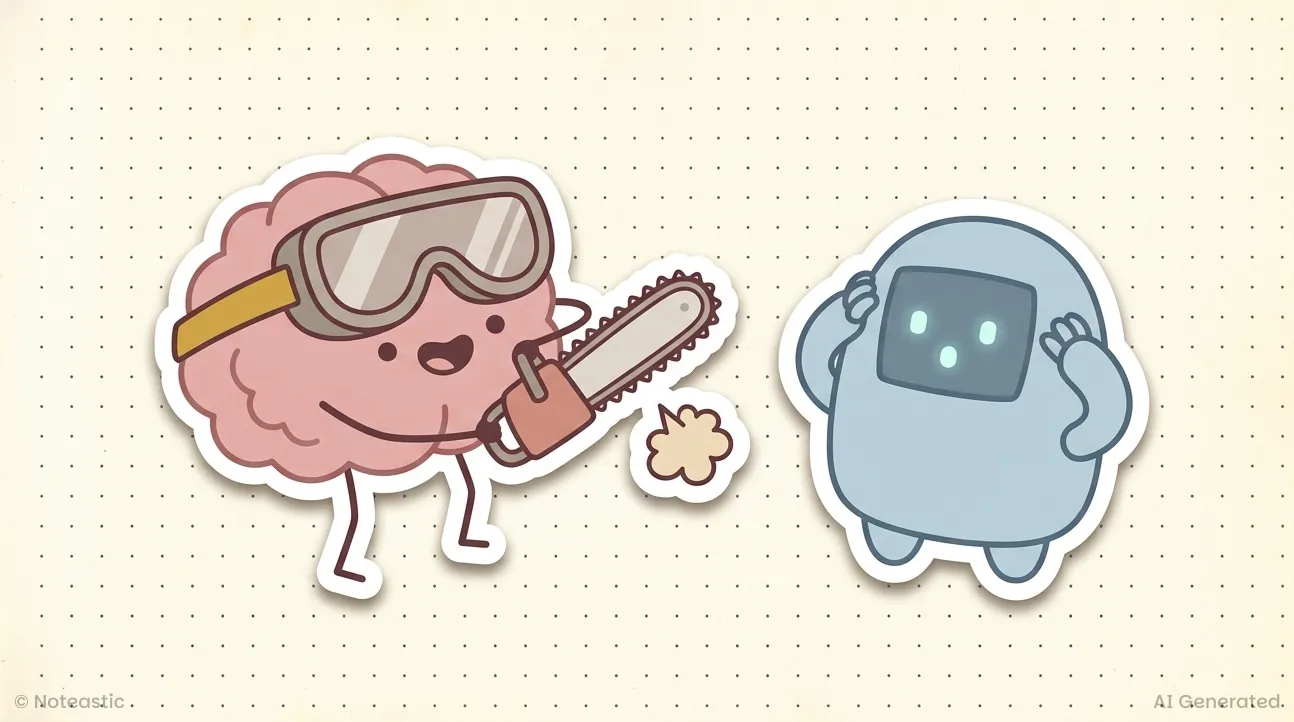
AI is everywhere. But even though it is revolutionary, it stays a tool. And tools need to be used wisely: first, to help you accomplish a given task optimally, and second, to avoid harming the user. Think of AI like a chainsaw. A chainsaw is also a mighty tool that can easily chop down a tree in your backyard, but it is also capable of chopping your leg off. How you use it and what safety precautions you take decide how the chopping experience turns out. AI is no different, but maybe a bit less morbid. Instead of your leg, your brain is at risk, and your capacity for critical thinking is in danger. That’s why responsible AI use is so important. In this blog, I want to share my opinions on how to safely use AI for note-taking, especially for learning, and what precautions to take to avoid diluting your intellect.
Why do we take notes?
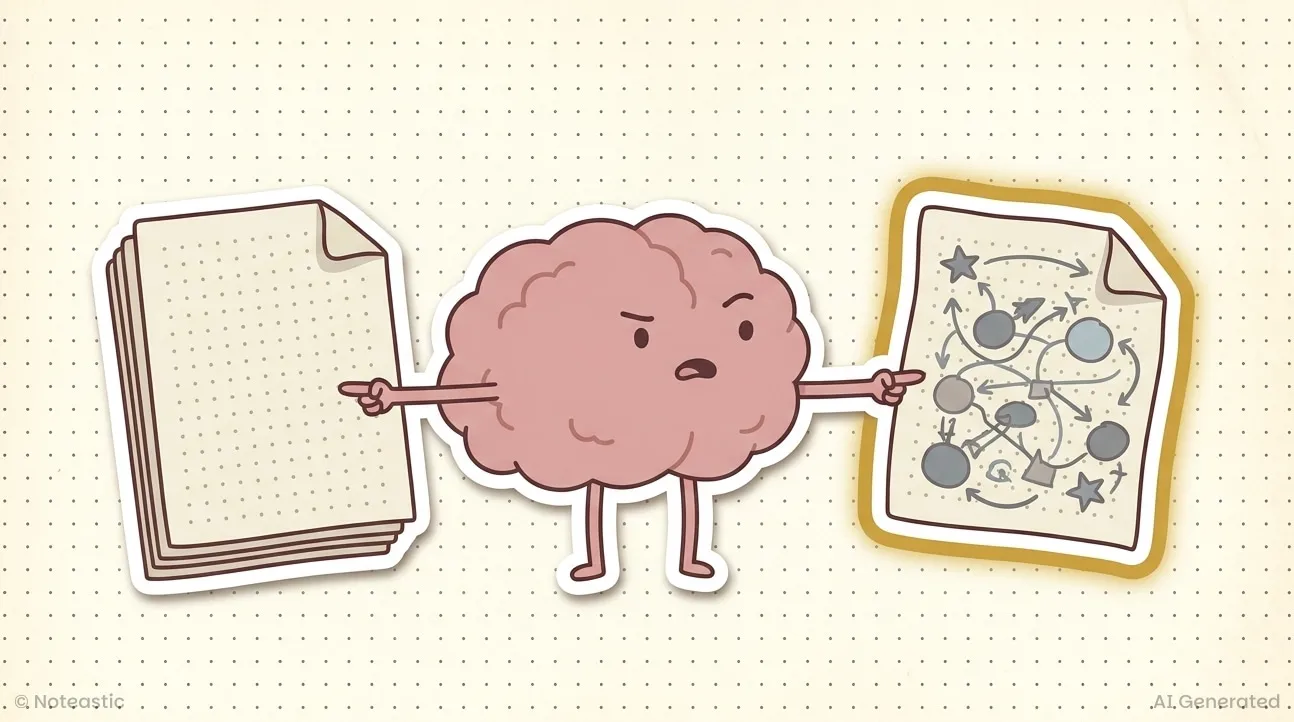
With big topics like this one, I think it is always important to start with the most basic facts to build a foundation for further thinking. And talking about AI in note-taking, the first question should be: “Why do we actually take notes? What do notes help us achieve?” For me, there are two major applications for note-taking: learning and documentation. Let’s start with the latter.
Documentation is the raw task of transcribing information to make it accessible. It involves little cognitive work because what you write down is the end product. If the information you write down is understandable to you at a later point in time, the note did its job. That’s why I think AI is fantastic to use for documentation. It takes away the grunt work of writing down facts you already know.
However, when we talk about learning and going through entirely new information that you can’t yet make sense of in full, it is a totally different topic. Taking notes when learning something new means compressing complex, not-yet-remembered information into a graphic representation on a digital or analog canvas (my clear preference is digital). You can do this by writing, placing shapes, arranging a composition, using colors, adjusting size, etc. The creative process of how to illustrate, i.e., encode, information onto a piece of paper so that you can read and understand it later is EXACTLY the kind of work your brain needs to do in order to learn. Learning is mental friction. Your brain has to do the heavy lifting. So you can’t outsource learning to AI. In the following paragraphs, I will take a closer look at how to use and how not to use AI in note-taking as a learning aid.
Where AI harms you in note-taking and learning
First, I want to shed light on the ways AI can inhibit learning by giving you three rules for using AI in note-taking. You could argue that I am suggesting we over-restrict the use of AI in learning with these, but hear me out. I use AI myself daily across all verticals of my life. I use AI at work (there is barely any task in Noteastic I do without using AI), at university, and for learning. But through all the AI exposure I’ve had, I have also come to critically question where this promising tool provides value and where it doesn’t.
Don’t let AI write your notes!
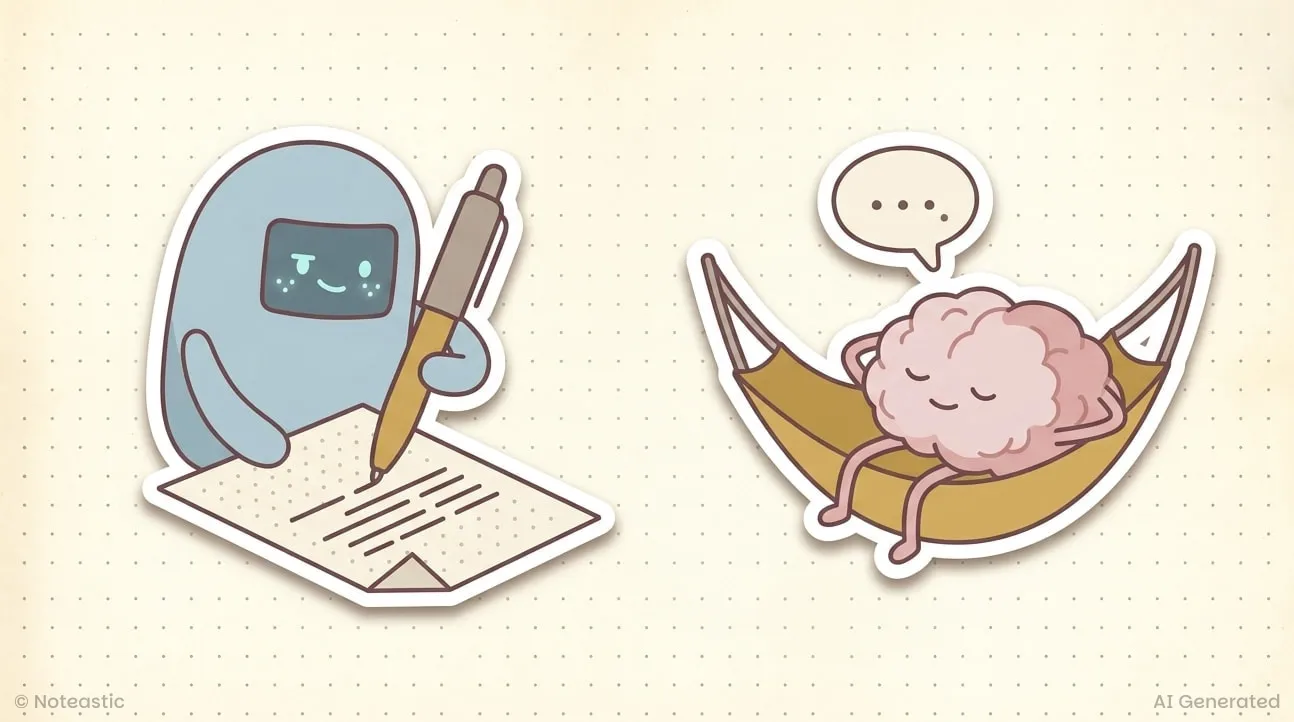
This should be a no-brainer, but AI just makes it so easy to get lazy. If you don’t engage with a topic mentally, you won’t learn or remember anything from it and will gain absolutely nothing. If you want to learn, you need to write your damn notes yourself! And there is no way around it.
That’s not simply my opinion. I went through the research for my typing versus handwriting blog. Firstly, the research says that it is irrelevant what you take your notes with – e.g., typing or handwriting.1 The ONLY thing that matters is how much your brain engages with the content while you are taking notes. Students who transcribe their lectures word for word write the most and understand the least, simply because copying requires no decisions.2 Now think about how much your brain engages when you don’t even type yourself anymore. A note should be what is left over after your brain has done the learning. And if you never did the work, there is nothing left over, no matter how good the note-taking page looks.
Don’t let AI summarize your notes!
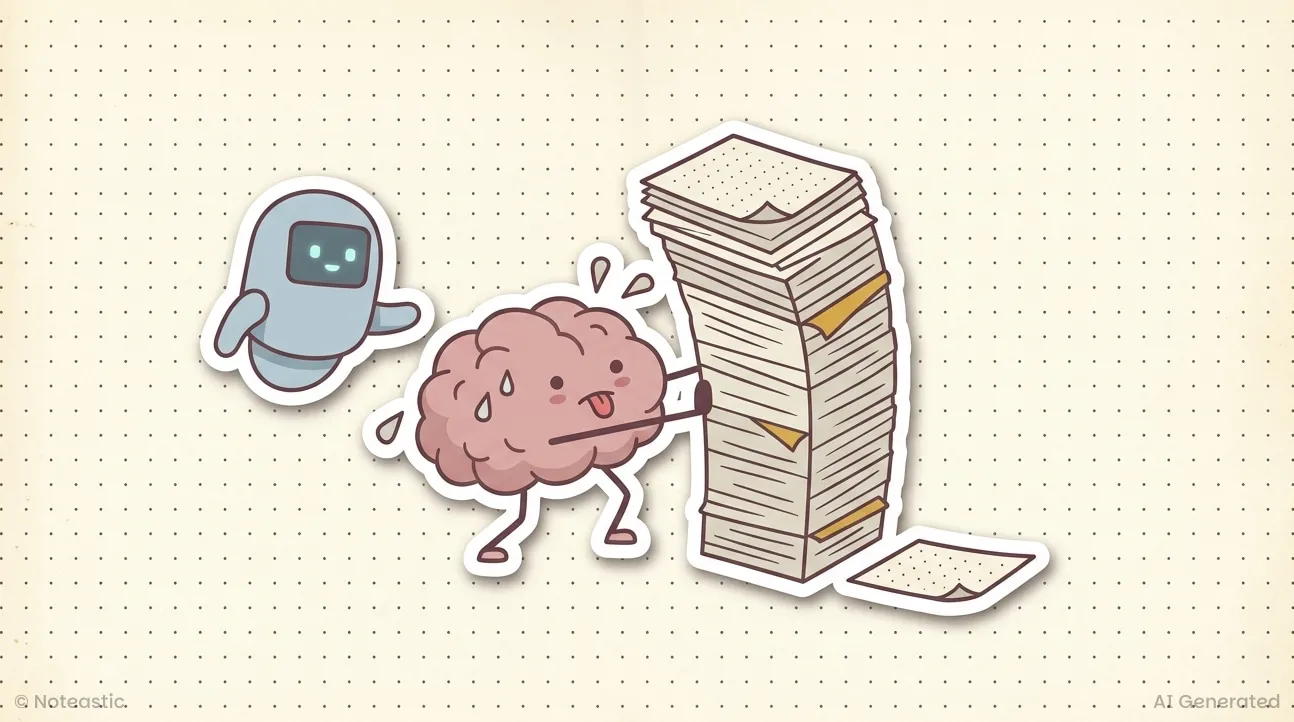
That’s an important one. I don’t want you to think of summarizing as mindless work. It’s quite the opposite. But I understand: you already sat through the lectures, you already have your notes, and now you ‘just’ need to pull everything together into something shorter. It seems like the perfect job to hand over to an AI… because doing it yourself is so exhausting. When you read this sentence, your alarm bells should already be ringing. Why is summarizing exhausting? Because your brain does TONS of work when summarizing. Compressing a lot into less without losing the most important information is cognitive heavy lifting!
Summarizing is so important because it is your perfect knowledge test. You know that you understand a domain when you can confidently sort concepts into essential and too detailed. For this decision, you need a holistic perspective on a topic and an understanding of how its parts connect. You can’t rank information by importance if you don’t understand the information itself and its dependencies and relations. So when you write your summary and decide what physically (or digitally) makes it onto your note page and what gets dropped, you are precisely strengthening the holistic overview that learning the topic was supposed to give you in the first place.
If you read carefully, you see that ‘writing’ the summary is not the part of summarizing I am stressing here. Making the active decision about what to include and exclude is. In that case, I would even advise you to not do the mindless work of copy-pasting text or handwritten notes yourself. Let an AI do the search and retrieval. But let it search and retrieve under your strict guidance.
Don’t let AI ‘improve’ your notes!
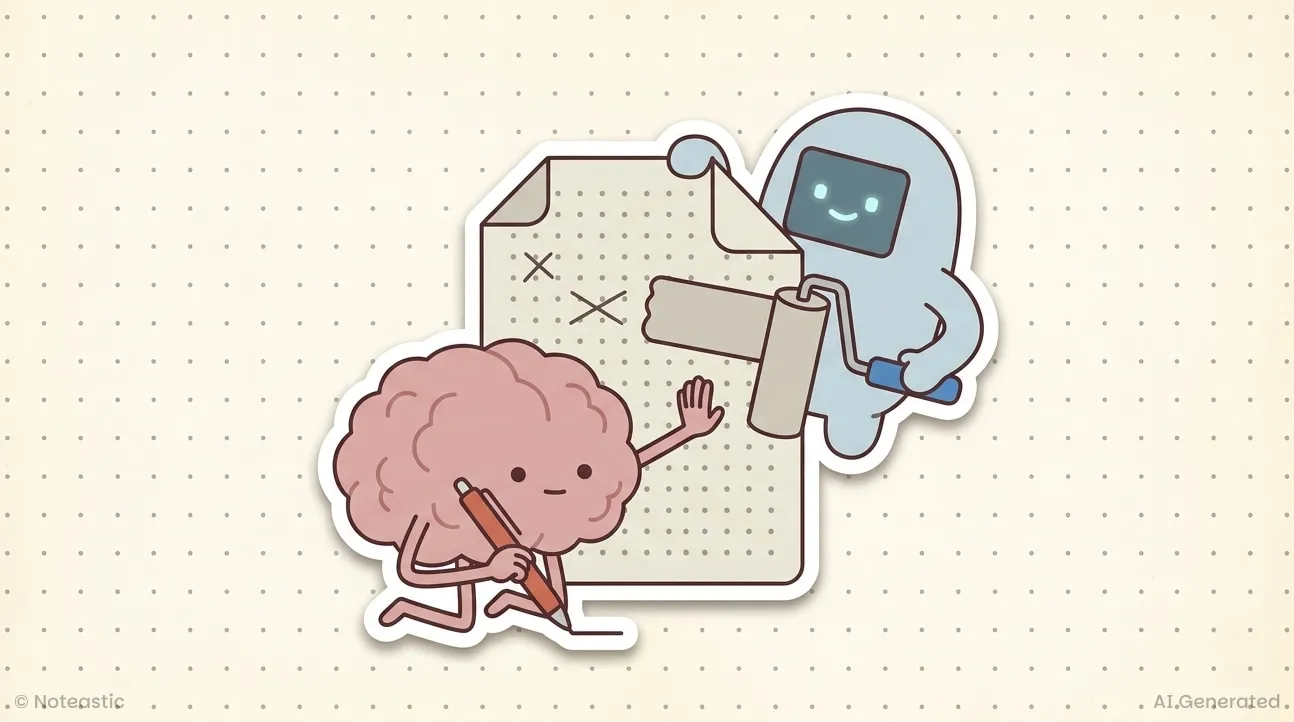
Letting AI ‘improve’ your notes is as much of a false promise as letting AI write your notes. Usually, when you want to update your notes, it is because you have gained a better understanding of a topic. It is natural to update older notes to correct fallacies or to sharpen findings. However, engaging with old notes, identifying mistakes, rewriting sections, rearranging your note-page and deleting (now) obsolete information based on your new and better understanding is NOT trivial work.
Again, this is exactly the time when knowledge starts to consolidate and strengthen, because you are forced to critically assess what you wrote in the past and use your new knowledge to re-judge every sentence you wrote prior. The fundamental facts will probably still be true; they might just need to be framed differently! Every sentence that you read and every graphic you look at goes through your new, more knowledgeable mental filters when you intuitively ask yourself, “Is this statement correct?”, “Is this statement comprehensive enough?”, “Is this statement missing information?”, “How can I correct this statement?”. Also, when you need to correct something or need to rewrite an entire section because it no longer holds, you engage in generative processing3 – i.e., making sense of your new knowledge and connecting it with the rest of the knowledge compressed in your brain.
Where AI helps you in note-taking and learning
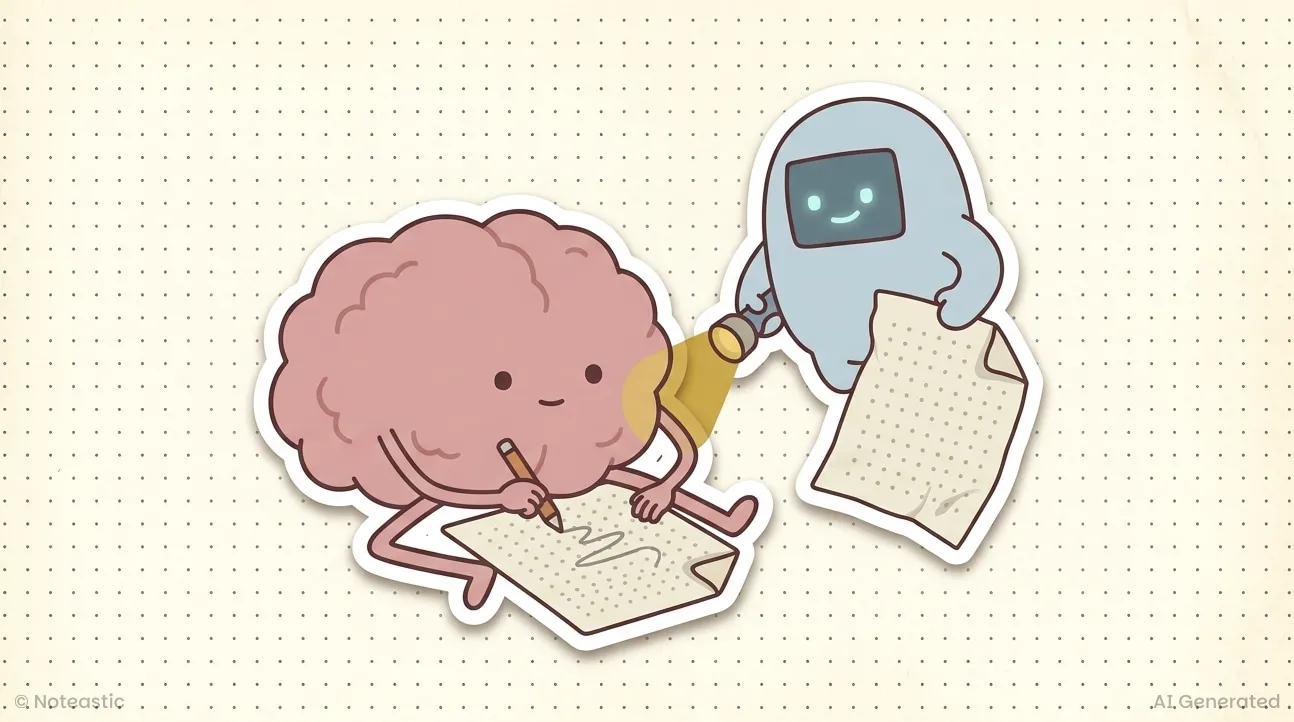
Now, this is a very exciting part of this blog, because as much as the use of AI can inhibit your learning, it can also foster understanding and critical engagement with a topic. The benevolent use of AI can help you learn faster, deeper, and more broadly than was possible in the past -mainly because AI can reduce crucial friction points in the learning process.
Search and retrieval
On an operative level, AI alleviates some of the most painful and simultaneously useless friction points. For example, searching and retrieving information. It just so happens that sometimes you need to find a specific piece of information buried somewhere between all the papers, slide decks, and notes you have amassed throughout a course. And now you don’t have to waste your time scrolling through hundreds of pages yourself anymore. If you are missing a specific piece of information, send an AI agent on a search trip! Given that the AI has enough context and clear instructions, it will probably do a good job of finding the exact piece of information you were looking for significantly faster than you could. That’s a superpower, because you don’t have to exit your mental learning state to stupidly search for a piece of text anymore.
Knowledge gap identification
This is a super interesting topic. You know, there are two distinct types of unknowns. Either you are aware of a gap in your knowledge (known unknowns) or, more dangerously, you are not aware of a knowledge gap (unknown unknowns).4 Unknown unknowns are a real saboteur, because when you lack competence in a domain, you probably also lack the meta-competence to recognize that you lack domain competence. The very knowledge you need to see your incompetence is the knowledge you don’t have. So the unknown unknowns stay invisible and might dangerously lead you to overestimate how much you actually know. That’s the Dunning-Kruger effect,5 and it was a difficult-to-circumvent risk… until now. Luckily, you have nearly the entire knowledge of the internet, and thus humanity, compressed into a chat interface. If you want to get tested, and especially tested on blind spots, most definitely an AI agent will find something to surprise you with! Identifying these knowledge gaps helps you turn your unknown unknowns into known unknowns before you can make them known knowns ;).
Knowledge testing
The next thing LLMs are amazing to use for is testing. It has never been so easy to generate a test case to use your newly acquired knowledge on! And the good thing about it is that even when the AI fails to give you a sufficiently well-designed test case, spotting what the assignment is missing is itself valuable! One way or another, you are forced to critically assess the given task and make use of the knowledge you just acquired. You are forced to connect the dots, and if you can’t, you should put in the effort to identify what is holding you back. Is it a lack of information in the task? Is it a lack of understanding of the domain? Is it a lack of tools? It is valuable if you can confidently answer these questions with a definitive yes or no, because these answers allow you to move forward accordingly. Either get the information you need or get back to the drawing board and review or expand what you learned!
“By the way” questions
For me, a pressing topic while learning new things is to draw connections to other fields of knowledge I have. Mostly, the things that I learn are somehow connected – or can somehow be connected – to other fields of expertise I have. Sometimes short clarification questions come up like “AH, so concept A is also observable in this totally different domain B?” or “Wow, so that means that processes in domain C can also be looked at from the perspective of this topic D?” And AI can give you at least somewhat satisfying answers to these questions. Just make sure the LLM isn’t blowing smoke and telling you you just made a Nobel Prize-worthy statement… that happens, so stay critical.
My AI Philosophy
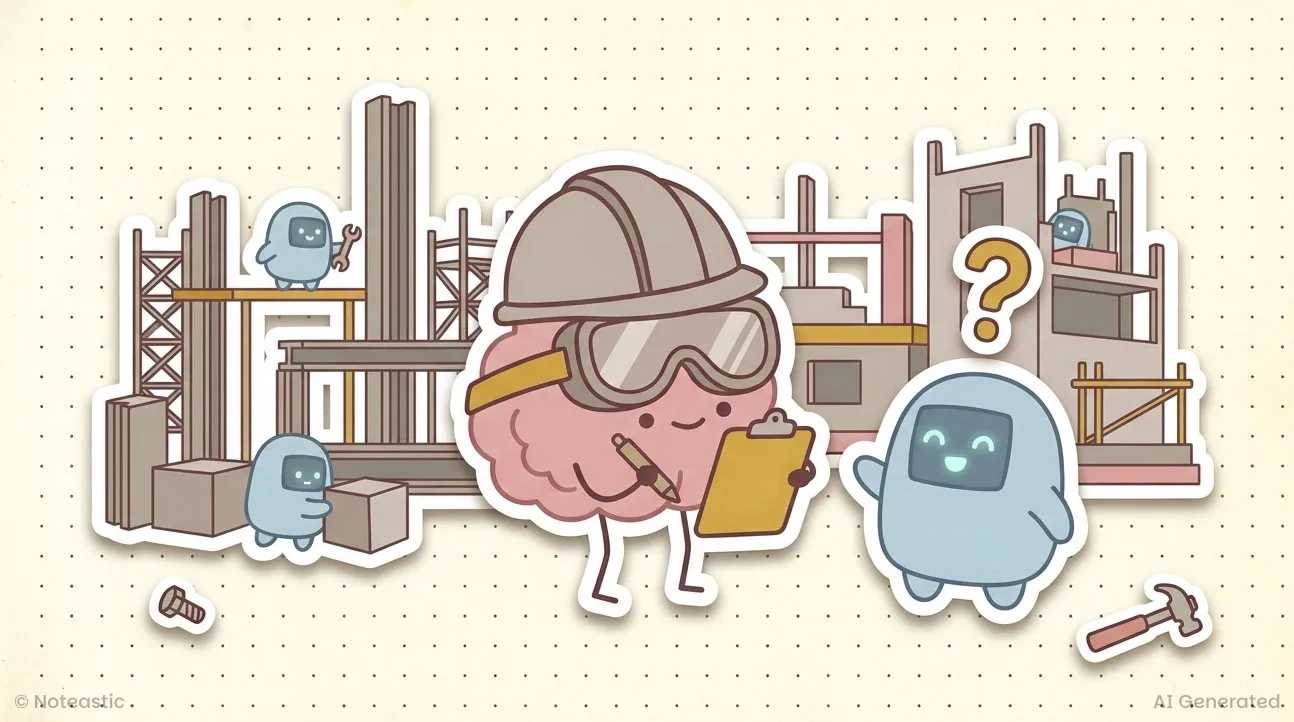
I think my convictions about how to use AI for learning and note-taking can be abstracted into the general AI philosophy I follow. Learning is simply the task that best depicts the general rules I always follow when interacting with LLMs. But there are a few fundamentals that also need to be understood, in my opinion.
AI doesn’t mean quicker, it means different
The most important thing to understand, in my opinion, is that working with AI will not make you faster (immediately). Getting faster with AI takes A LOT of preparation, even more experience, and a TON of typed text.
Instead of being able to intuitively tackle a problem by yourself, conversing with your own mind, you now have to bring and keep a natural-language assistant – the LLM – on board. This means that articulation, process design, and quality control become central determinants of success.
- If the AI does not understand you well, it will output worthless text, so you need to nudge and brief the AI better = Articulation.
- If the AI jumps from step one to step three without you and makes assumptions that don’t hold, then the working process is not adequate = Process Design.
- When the AI throws bold assumptions and ‘atomic options’ at you without much thought, the LLM’s self-enforced quality gates are too low and need to be lifted = Quality Control.
Let me underline my point with an example. Let’s say you are trying to solve a mathematical equation: 2x = 10. If you simply throw this equation at an LLM, it will give you a quick answer of x = 5. If your goal is to start learning about how variables work, how solving equations works, or even how the mathematical operation of multiplication works, you need to add context to this small formula. You need to tell the AI that you don’t know the solution and that you want to understand how to get there step by step, starting with the smallest piece of knowledge that gets you there. You must specify to the LLM that you want it to behave like a professor rather than a know-it-all and to nudge you towards the solution bit by bit instead of telling you upfront. You should also specify that you want to work one step at a time and that a new concept should only be introduced when the prior concept is fully understood, so you don’t overload yourself. Now take a look at this paragraph. The solution to the simple formula 2x = 10 turned into four sentences that specify what you need to tell the AI. Communicating this information to an AI will require an entire paragraph for every single point. This is a lot of text, and this text needs to be written by someone – or rather, you.
Writing text, composing thoughts, and expressing concepts in a conclusive way simply takes energy and time.
No-trust towards LLMs by default
LLMs are designed to output text that looks and feels correct, even or especially when throwing around jargon. This is exactly the danger of it, because everything an LLM puts out can be interpreted as at least viable. This is why you should not trust your LLM by default. Whatever an AI puts out must earn your trust first. And this should happen by citation of sources, your independent examination of these sources, and subsequently your gain in knowledge about the domain you are navigating in. That’s exactly the goal.
Don’t try to jump to the peak of the mountain instantly by trusting the AI. Rather, learn to climb the mountain quicker by learning through the AI and actively using the weaknesses of LLMs to your advantage!
I hold a quote by Marie von Ebner-Eschenbach very dear in this context:
“Whoever knows nothing must believe everything”
Do the intellectual heavy lifting yourself
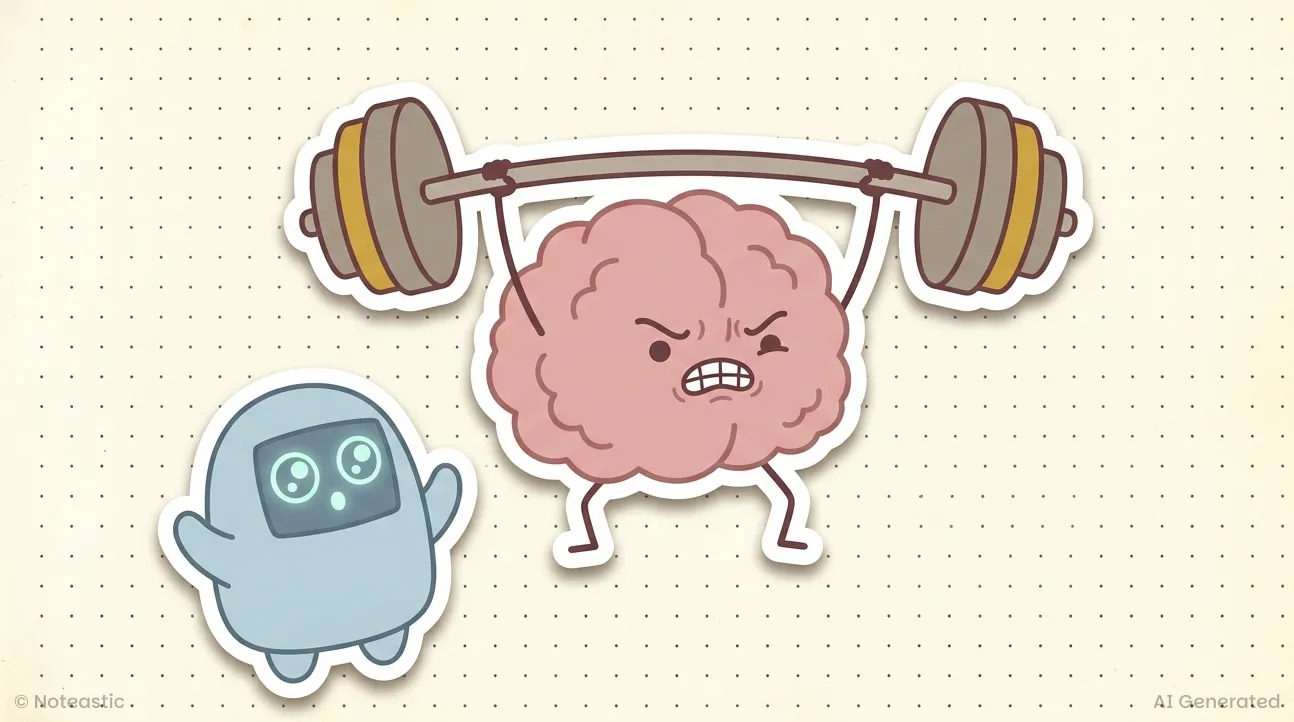
Exactly because of this dangerously manipulative nature of LLMs, it is important that you keep authority over the work process. You must approve the steps on the route to solving a problem. You must understand and approve every critical step and every fundamental dependency. This means you must understand the core concepts and key information. Difficult decisions need to be made by you, and in the end you need to be the master of the AI, not the other way around. It is easy to drift off and to be overwhelmed by vast text outputs of LLMs that feel endless to read. It is your responsibility to shape the AI to support YOUR learning, not to become a leaf in the AI’s wind.
Using AI means thinking more, not less
All these realizations bring me to the confident conclusion that using AI should not make you think less, but do quite the opposite. Using AI properly forces you to think more, to consistently question your interaction with an LLM on a meta level, and to actually do more intellectual heavy lifting in a more concentrated time frame. This is fatiguing. But a learning process that once took you a week can now be compressed into a day. This is the beauty of it.
Use AI to achieve more, not to do less
Quite a fundamental part of using AI is your attitude toward work and effort. With a tool that makes your time and effort 3x more productive, you have two choices. Either you start working only a third of the time to achieve the same as before. Or you work the same time and simply output three times as much as before.
The place of AI in Noteastic
I am the designer of Noteastic, the handwritten note-taking application made for Windows. These are some interesting times my co-founder and I are navigating. We see implementations of AI in software all around us and, frankly, we do not approve of most of it. We understand that the future of humankind is bound to AI; however, it is our responsibility to foster responsible and, most of all, beneficial use of AI. This headline is easy to say, but the grand question is what responsible and beneficial use of AI looks like in practice, inside of a handwritten note-taking app directed at students, made with the promise to improve learning. This is quite some responsibility.
The question I keep coming back to is:
“Where does AI help in handwritten note-taking without incurring intellectual harm?”
We don’t have the answer yet; however, I think a few convictions will hold true indefinitely.
What AI will NOT be in Noteastic
I say no to AI agents doing ‘intellectual’ work inside the note universe of our users. Noteastic users should have exclusive, full authority over the work connected to designing, writing, and maintaining their notes on a page. No AI should be allowed to write, reorganize, or put any kind of element on the Noteastic canvas. This way, I think, we can help people the most in actual learning. We will not provide a surface for a random computer agent to draw on and to take over one of the last safe spaces for authentic thoughts. The Noteastic note-page will be among the last surfaces not conquered by senseless AI.
What AI may be in Noteastic’s future
However, I am not plainly saying no to AI in Noteastic. I am a supporter of responsible AI use. The question is where we could assist learning inside of Noteastic, and I already gave the answer in a prior paragraph. Tedious non-intellectual work can definitely be outsourced to AI without hesitation. This includes search and retrieval tasks, text recognition (i.e., transcription into machine-understandable letters), and shape recognition for quicker drawing of complex illustrations. I am sure we will add features that solve these issues in the near future.
More profoundly, it would be interesting to assess the magnitude and breadth of knowledge gain by analyzing notes. How cool would it be if you could learn together with an integrated AI model that tells you how much of a target domain you learned, where you might have knowledge gaps, and how you could close them? If Noteastic ever implements interactive AI within the application, it will be a pilot project to push the frontier of knowledge acquisition, knowledge verification, and knowledge gap identification. Maybe Noteastic will one day not ‘simply’ be the notebook you write your thoughts into, but the learning partner that slowly guides you towards attaining your intellectual goals. This sounds exciting, but I am very aware that such projects don’t fail in the ideation phase; they fail in the implementation phase. Time will tell whether we have what it takes to lift Noteastic from a mere note-taking app to your next learning superpower.
-Lukas
Co-Founder and CEO of Noteastic
PS: If I triggered a spark in you while you read this blog, I’d love to hear about it. Just send me an email to lukas.koinig@noteastic.app!
References
-
Voyer, D., Ronis, S. T., & Byers, N. (2022). The effect of notetaking method on academic performance: A systematic review and meta-analysis. Contemporary Educational Psychology, 68, 102025. https://doi.org/10.1016/j.cedpsych.2021.102025 ↩
-
Mueller, P. A., & Oppenheimer, D. M. (2014). The pen is mightier than the keyboard: Advantages of longhand over laptop note taking. Psychological Science, 25(6), 1159-1168. https://doi.org/10.1177/0956797614524581 ↩
-
Wittrock, M. C. (1974). Learning as a generative process. Educational Psychologist, 11(2), 87-95. https://doi.org/10.1080/00461527409529129 ↩
-
The phrasing “known unknowns” and “unknown unknowns” was made popular by Donald Rumsfeld at a U.S. Department of Defense news briefing on February 12, 2002. ↩
-
Kruger, J., & Dunning, D. (1999). Unskilled and unaware of it: How difficulties in recognizing one’s own incompetence lead to inflated self-assessments. Journal of Personality and Social Psychology, 77(6), 1121-1134. https://doi.org/10.1037/0022-3514.77.6.1121 ↩